Docking At Sunset With 12 Knots On The Beam: A Three‑Step Plan That Actually Works
You’re easing back into the harbor at sunset. The slip is narrow, the gelcoat is fresh, and now there’s 12 knots of wind blowing straight across your beam. This is the moment when boats get bumped, tempers spike, and pride takes a hit.
It doesn’t have to go that way.
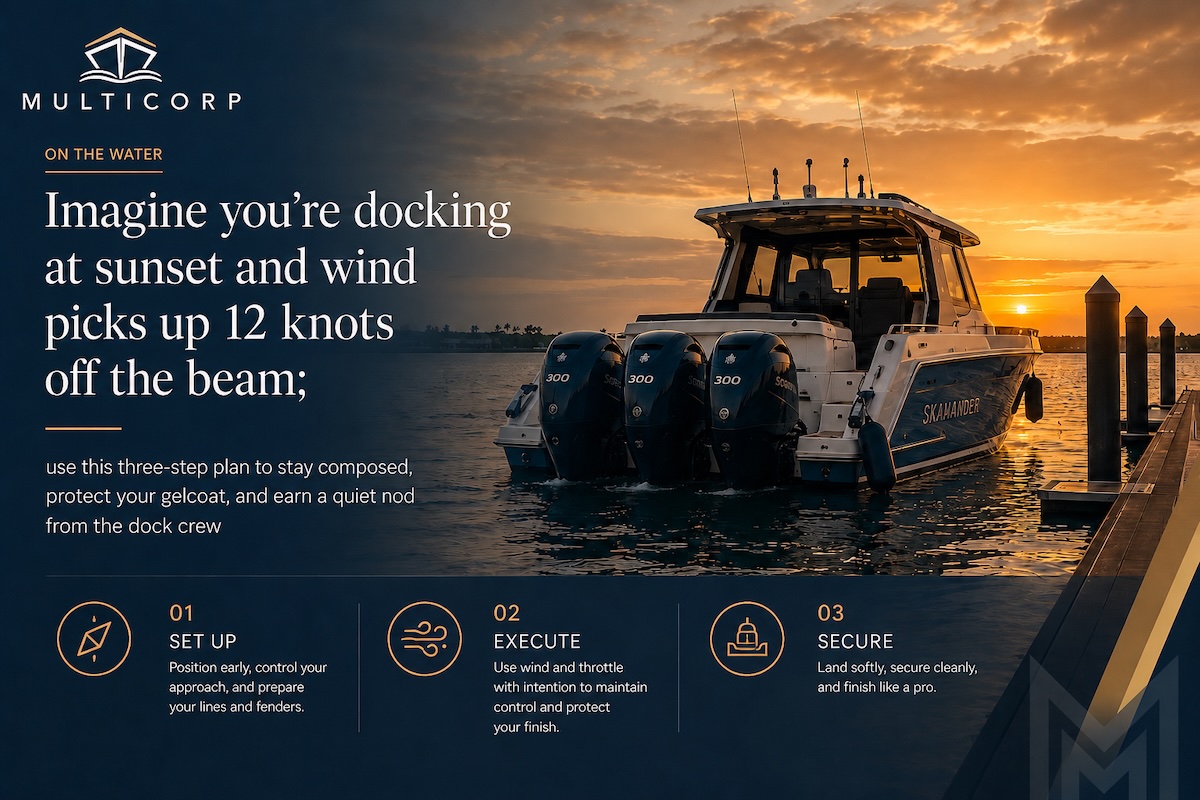
Here’s a simple three‑step plan, built on real-world experience, to keep you composed, protect the boat, and earn that quiet nod from the dock crew.
Step 1: Stop “Parking The Boat.” Start Positioning The Hull.
Most docking mistakes start with the wrong mental model. You’re not parking a car. You’re positioning a hull in moving air and water.
Before you turn into the fairway, take 20 seconds to reset:
-
Read the wind, not just the flags.
Look at:- Surface ripples on the water
- How other boats are drifting in their slips
-
The angle of your burgee or antenna pennant
Confirm: wind is on the beam, pushing you sideways off the dock.
-
Decide your “drift plan.”
With beam wind, you’ll either:- Use the wind to push you onto the dock, or
- Fight to keep you off the dock while you step in, then let the boat come alongside under control.
Choose the approach that gives you the slowest possible contact and the clearest exit if something changes.
-
Visualize your final position.
Before you move, picture:- Bow line secured
- Stern line secured
-
Fenders taking the load at the contact points
Now, all you’re doing is driving the boat from “out here” to that final picture.
This is the same mindset we use in aviation: understand the forces, plan the energy, then execute the maneuver. No surprises, no last‑second heroics.
Step 2: Rig Like The Wind Is 20 Knots, Even If It’s 12
Fenders and lines are cheaper than gelcoat. Set the boat up to be wrong gracefully.
Fenders: Protect The Gelcoat Before You Need To
When the wind is on the beam, assume you will touch the dock. That’s not failure. That’s physics.
-
At least three fenders on the dock side
- One at the widest point of the hull
- One forward near the flare
- One aft near maximum beam
-
Set height for the dock you’re actually landing on.
Too high or too low turns them into ornaments. The contact face should be centered on the dock edge. -
Add a “roaming fender.”
Keep one extra fender ready in the cockpit. If the slip is tight or pilings are uneven, a crew member can drop it where it’s needed most.
Quality European builders like Parker Poland design robust hulls and strong rubrails, but they’re not meant to be your primary docking system. Let the fenders do the work.
Lines: Control The Boat, Don’t Wrestle It
Lines are your low‑tech, high‑leverage control surfaces. Rig them with intent:
-
Prepare a midship spring line first.
This is your primary control in a crosswind. Cleat at the midship cleat, run it forward to a dock cleat or piling you can reach early. -
Have bow and stern lines ready to deploy, not piled in a knot.
- Flake each line so it runs clean
- Keep the bitter end in the hand of the person who will step ashore
-
Assign jobs.
- One person on midship spring
-
One person responsible for bow or stern, not both
Call out: “You’re midship spring. You’re bow. No one jumps until I say we’re stopped.”
This is where disciplined systems knowledge shows. A well‑set spring line and a 5‑second pause can save you from 5 minutes of scrambling and shouting.
Step 3: Use Power In Bursts, Not As A Crutch
In a crosswind, continuous throttle usually makes things worse. Controlled, short applications of power—combined with your lines—give you precision.
Approach: Slow Is Smooth, But Not Drifting
You want enough way on to maintain steering control, but not so much that you can’t stop within a boat length.
-
Come in at a shallow angle.
Approach with the bow slightly into the wind if possible, so the wind helps you “feather” toward the dock instead of shoving you sideways. -
Keep one hand on the throttle, one eye on the drift.
If you feel the boat being blown off faster than you’re moving ahead, you’re too slow or too light on power. Correct early, in small bites.
Commit To The Line, Not The Leap
The cleanest, quietest dockings share the same move: the midship spring.
-
Land the midship first.
- Bring the boat alongside just enough for your crew to step (never jump) onto the dock with the midship spring.
- Once it’s on, call clearly: “Midship made.”
-
Use gear to “lean” on the spring.
- With midship secured and the rudder turned gently away from the dock, ease the engine into forward idle.
- The boat will pull against the spring, swinging the stern in while holding your position.
-
Then secure bow and stern lines.
- With the boat “pinned” under gentle power, you have time to calmly pass and cleat the bow and stern lines.
- Shift to neutral, double‑check tension, and you’re home.
You’ve just done what good captains and good pilots do: let the system work for you. No drama, no gelcoat damage, no raised voices.
Bonus: How Modern Hull Design Helps You In This Moment
On a well‑engineered boat like a Skamander by Parker Poland, advanced hull shapes and efficient drivetrains give you better low‑speed authority:
- Vacuum‑infused hulls and balanced weight distribution respond predictably at idle.
- Modern thruster and engine controls allow precise, short bursts of power.
- Intelligent deck layouts keep crew movement safe and clear during docking.
You still need to know what you’re doing—but when hull and systems are designed for real‑world use, the margin for error gets wider, and evenings at the dock get quieter.
Why This Matters More Than A Perfect First Try
Docking with wind on the beam is where most ownership stories get dented—literally and financially. When you approach it with a simple, disciplined plan, three things happen:
- You protect your gelcoat and hardware.
- Your crew trusts you more, because the process feels calm and repeatable.
- You start to enjoy close‑quarters maneuvering instead of dreading it.
That’s the foundation of better ownership: preparation, smart systems, and support that doesn’t disappear after the sale.
Guided Ownership, From Docking To Long‑Term Planning
At MultiCorp Yacht Sales, docking is just one small part of “A better way to own a boat.” We combine aviation‑level discipline, deep systems knowledge, and award‑winning European boatbuilding like Skamander by Parker Poland to help you choose well, plan intelligently, and stay on the water—without interruption.
If you’re ready for a more disciplined, supported approach to boat ownership, reach out to MultiCorp Yacht Sales for a conversation. Not inventory. Not pressure. Just what’s right for you.