
Fog on the Chesapeake Bay and a falling inland-lake level demand different information at the helm. Buying every available electronic option is an expensive way to prepare for both.
For a new Skamander by Parker Poland, start with your cruising routes and the decisions you will make underway. The best package makes essential information easy to find while preserving useful backup capability. It also avoids paying twice for functions you rarely use.
Radar for visibility that can change
For coastal cruising and longer Great Lakes passages, radar moves up the priority list. It can help identify shorelines and vessels in reduced visibility, although small or low targets may be missed. It does not replace a lookout or a speed suited to conditions.
A compact solid-state radome is a sensible starting point for many recreational cruisers. An open-array antenna can improve target separation, but its greater size and cost deserve a specific reason, not an automatic upgrade.
Pay attention to mounting location and the display. If chart and radar split-screen views become too small to read in chop, a larger screen or second display may serve you better than extra software features. Learn to interpret the radar picture in clear weather, before relying on it in fog.
Sonar that answers the cruising question
For general cruising, reliable depth information is more useful than elaborate fish imagery. A conventional depth sounder or CHIRP sonar with a correctly installed transducer is a sound starting point. Side-scanning features become easier to justify when fishing is a regular part of the day.
Ordinary downward-looking sonar shows depth at the boat, not a safe route ahead. Confirm what the displayed depth is referenced to, and account for the outboard’s operating draft when setting a shallow-water alarm. In a Chesapeake creek or reservoir cove, use current charts alongside actual water levels. Slow down well before uncertain depth becomes an urgent problem.
Forward-looking sonar may add useful information in unfamiliar shallows. Its range and interpretation limits still matter, so treat it as another source of information rather than permission to keep moving.
Autopilot for long legs, not unattended running
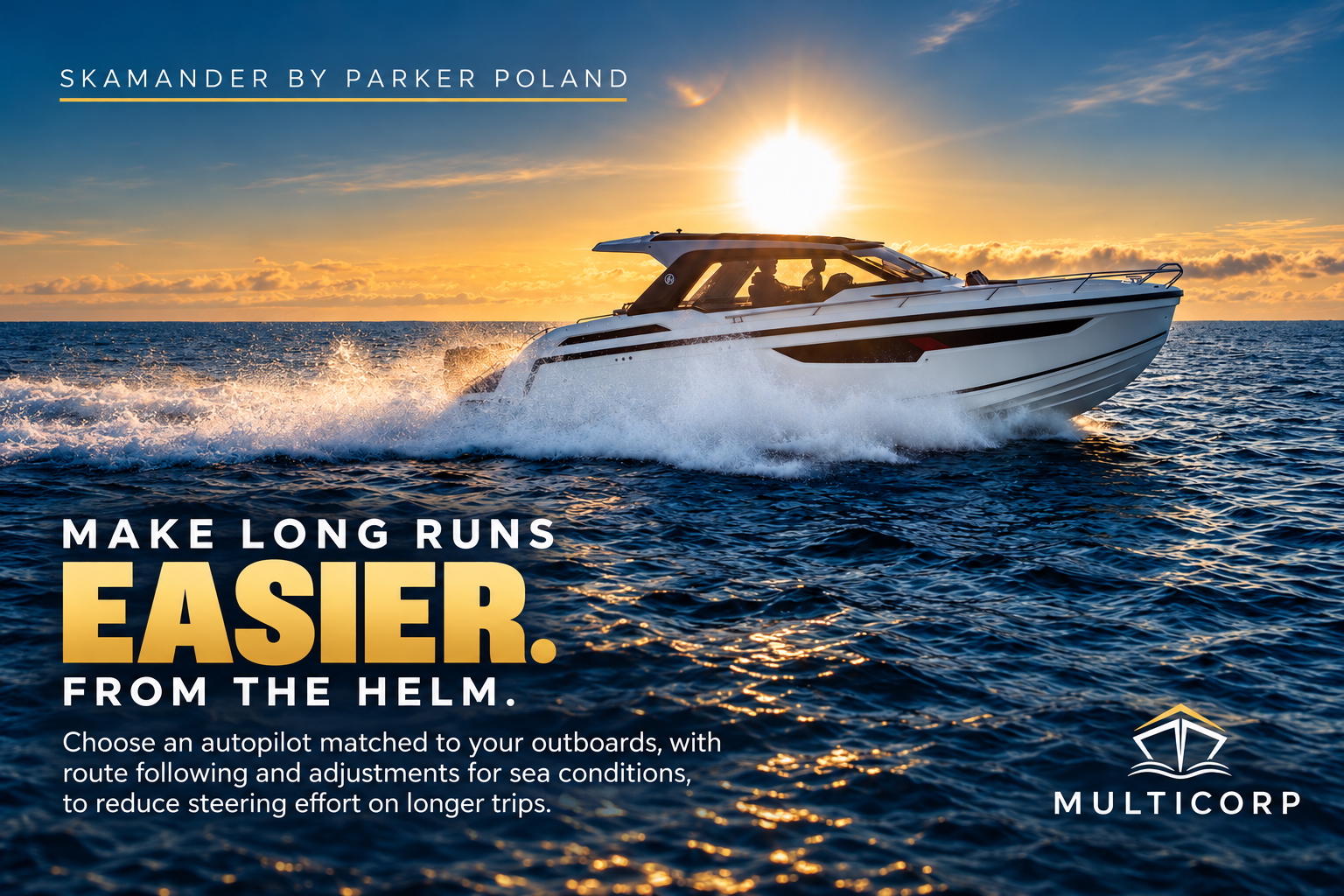
An autopilot can reduce the workload of holding a course during long open-water legs. On a boat used mainly for short lake outings, it may be a lower priority than a readable chartplotter and dependable depth.
Confirm compatibility with the exact outboard steering system before choosing the pilot. Shared branding or a network connection does not automatically mean every steering function will work together.
The pilot handles steering, not the lookout. Do not expect it to avoid traffic or floating obstacles. In chop, the operator still manages speed and trim and decides whether conditions call for hand steering. Learn how to disengage it quickly, and review any chartplotter route before allowing the pilot to follow it.
Power management starts with a load budget
Start with a load budget, not a larger battery. Estimate electronics consumption alongside cabin loads such as refrigeration, both underway and at anchor.
- Keep engine-starting reserves protected from house loads.
- Check charging output at realistic engine speeds, not only the alternator’s headline rating.
- Use a properly configured battery monitor to track house-bank consumption and remaining charge.
- Specify clearly labeled, appropriately protected circuits so faults are easier to isolate.
A lithium house-bank upgrade also needs compatible charging and battery protection. More capacity alone does not solve a poorly matched electrical system. A low-voltage alarm is useful, but it is no substitute for knowing how long the boat can support your normal loads.
If digital switching is offered, ask how essential circuits are controlled when the main screen is unavailable. Putting controls on a display is helpful only if ordinary tasks remain straightforward and faults are manageable.
Buy integration without losing backup capability
Before approving the order, ask which display features are already included and which require additional hardware or subscriptions. Confirm whether one compatible heading sensor can support both radar overlay and autopilot rather than buying overlapping components.
Keep a DSC-capable VHF radio with GPS position data in the plan. AIS can add useful identification and movement information for equipped vessels, but it does not show every boat and is not a substitute for radar. Preserve a backup navigation method that does not depend on the main display or its power supply.
At MultiCorp Marine, we help with Skamander model selection and factory-order configuration. Bring us your typical route and time at anchor, and we can help you work through the equipment priorities before you order.