
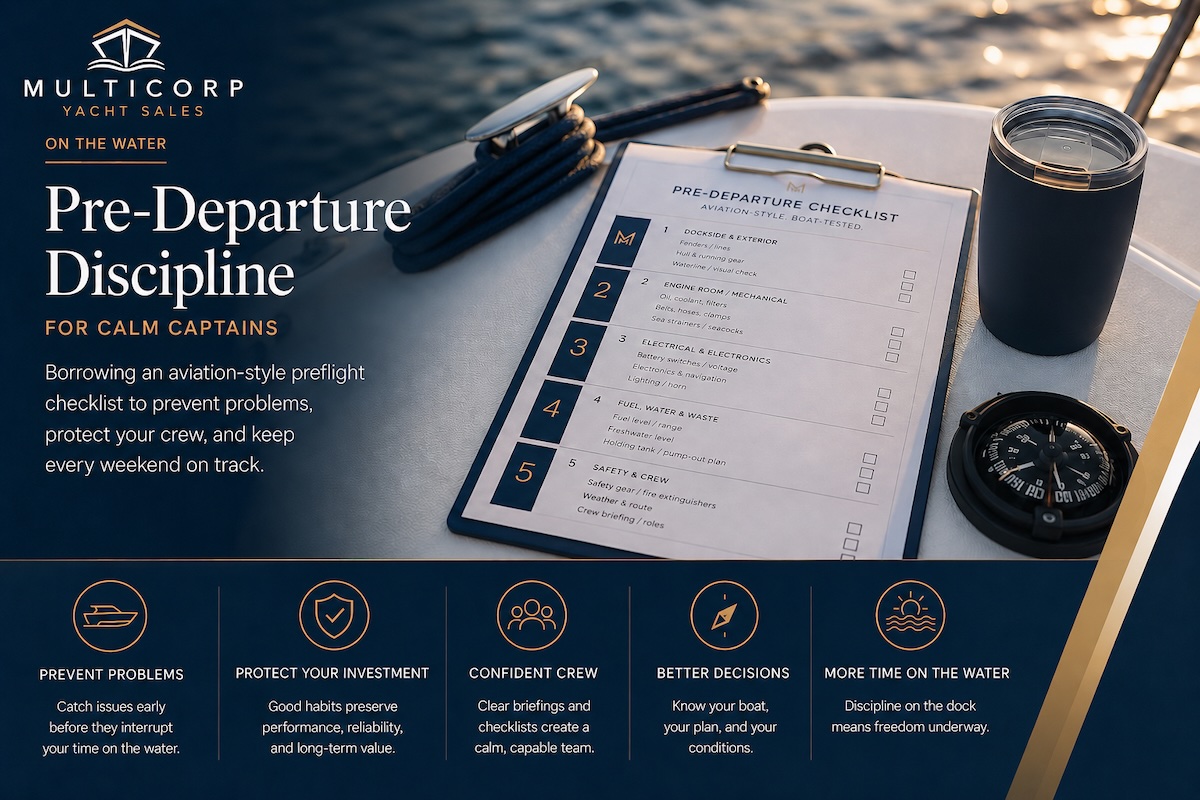
Pre-Departure Discipline for Calm Captains: Borrowing an Aviation-Style Preflight Checklist
A great weekend on the water is rarely “lucky.” It’s usually the result of disciplined preparation that quietly prevents problems before they happen.
At MultiCorp Yacht Sales, we bring aviation-style thinking to boat ownership: clear systems, repeatable checklists, and a focus on avoiding the issues that ruin trips. A good pre-departure checklist is a simple, low-cost way to trade stress for confidence.
Below, we’ll walk through the five problems most likely to wreck a weekend—and how to catch them with a practical, aviation-inspired preflight. At the end, you’ll find a link to download a ready-made, print-and-laminate checklist template.
Why Borrow from Aviation?
Before boats, our team spent decades in aviation—matching clients with the right aircraft and managing those assets over time. In that world, “preflight discipline” isn’t optional. It’s how you avoid expensive surprises.
That same mindset works on the water:
- Precision over guesswork
- Systems thinking instead of “it’s probably fine”
- Checklists that make experience repeatable
- Calm, informed decisions when something isn’t right
Applied to boating, aviation-style discipline turns you into a calmer captain and gives your crew more confidence in you and in the boat.
The Five Issues Most Likely to Ruin a Weekend
Most ruined weekends trace back to one of a few avoidable failures. Your checklist should be designed to catch these, every time.
1. Power Problems: Dead Batteries & Electrical Gremlins
Nothing kills momentum like a starter that won’t turn.
Common culprits:
- Weak or uncharged batteries
- Loose terminals or corroded connections
- House loads (fridges, lights, pumps) draining batteries at anchor
Preflight-style checks:
- Visual: Confirm battery switch positions (Start/House/All as appropriate).
- Voltage: Check battery monitor or gauge before starting.
- Connections: Look for corrosion, loose wing nuts, or damaged cables.
- Load test: Turn on key systems (electronics, pumps, lights) and watch for abnormal voltage drops.
On a Skamander by Parker Poland, electrical systems are engineered for reliability and efficient power distribution—but even the best systems need a disciplined once-over before you push off.
2. Fuel & Range: The Quiet Anxiety in the Back of Your Mind
Running a boat with “I think we’ll be fine on fuel” in your head is unnecessary stress.
Preflight-style checks:
- Fuel quantity: Don’t just look at the gauge—know your recent consumption and range at your typical cruise RPM.
- Fuel quality: Look at your water-separating filter bowl. Any water or unusual debris?
- Trip plan: Confirm distance (out and back) plus a generous reserve, especially for offshore or open-bay runs.
- Conditions: Account for headwinds, currents, and time spent at higher speeds.
We encourage clients to think in range and reserves, just as we do in aviation—not in “we probably have enough.”
3. Cooling & Mechanical Systems: The Overheat That Ends the Day
Many engine failures and tows start with a simple cooling issue.
Preflight-style checks:
- Raw water intake: Clear of debris, lines, or growth.
- Sea strainers: Baskets clean, lids sealed, no visible leaks.
- Belts & hoses: Proper tension, no glazing, no cracking or bulging.
- Oil & fluids: Check levels on engines, drives, and transmissions where applicable.
- First minutes of run: After start-up, confirm strong cooling water flow at the exhaust and normal temperature rise on gauges.
Skamander’s advanced hull design and robust construction are built for real-world conditions—but disciplined mechanical checks are what keep that capability available every weekend.
4. Bilge, Pumps & Below-the-Waterline Leaks
A slow leak or inoperative bilge pump can escalate quickly.
Preflight-style checks:
- Bilge status: Dry or only normal residual water? Anything unusual needs attention.
- Bilge pumps: Test manual and automatic operation; verify float switches activate reliably.
- Thru-hulls & seacocks: Confirm open/closed positions are correct and handles move smoothly.
- Hose clamps & fittings: Look for rust, looseness, or cracking on hoses below the waterline.
This is where disciplined, hands-on inspection matters. You don’t need to be a mechanic to spot a clamp that’s about to fail.
5. Navigation, Safety & “Human Factors”
Most boat days derail not from one big failure, but from small oversights that stack up: confused crew, missing gear, or uncertain weather.
Preflight-style checks:
- Electronics: Power up chartplotter, GPS, radar (if equipped), VHF. Confirm correct charts and position.
- Safety gear: Life jackets sized and accessible, fire extinguishers in date, flares in date, throwable device ready, sound device on board.
- Anchoring: Correct anchor, chain, and rode for the day’s depth and conditions; windlass checked for normal operation.
- Weather & sea state: Check forecast, wind, and any advisories. Make a plan B.
- Crew brief: Who’s comfortable with lines, fenders, and basic safety? Who’s new? Set expectations calmly.
In aviation, “human factors” training recognizes that people—not just machines—affect safety. Calm, simple briefings with your crew reduce stress and avoid confusion at the dock and underway.
Turning This into a Repeatable Pre-Departure Checklist
The key is consistency: the same flow, every time, so you don’t miss steps.
Consider structuring your checklist like this:
-
Dockside & Exterior
- Fenders/lines organized
- Hull, prop(s), outboard(s), and drive(s) visually inspected
- Waterline check: any new stains, growth, or list?
-
Engine Room / Mechanical
- Oil, coolant, and fuel filters checked
- Belts, hoses, and clamps inspected
- Sea strainers and seacocks verified
-
Electrical & Electronics
- Battery switches set, voltage verified
- Essential electronics powered and functioning
- Lighting and horn tested
-
Fuel, Water & Waste
- Fuel level confirmed against trip plan
- Freshwater level checked (if applicable)
- Holding tank status and pump-out plan known
-
Safety & Crew
- Safety gear accounted for and accessible
- Weather and route reviewed
- Crew briefed on roles for departure and return
This doesn’t need to feel bureaucratic. Done right, it’s a five- to ten-minute rhythm that becomes part of how you enjoy the boat.
Download a Ready-Made Pre-Departure Checklist Template
We’ve built a practical, aviation-inspired pre-departure checklist you can print, laminate, and keep at the helm or in your logbook. It’s tailored to real-world powerboat use, with space to adapt it to your specific boat.
Download your free Pre-Departure Checklist Template from MultiCorp Yacht Sales [here].
(Attach digital link or PDF download on your site.)
Use it as-is, or make it your own. The goal is simple: ownership, without interruption.
Guided Ownership, On and Off the Water
A disciplined pre-departure checklist is just one part of “A better way to own a boat.”
At MultiCorp Yacht Sales, we:
- Help you choose the right boat, not just the available boat
- Bring aviation-level discipline to financing, planning, and systems understanding
- Back every sale with Command365—real people, on call, to keep you on the water
If you’re ready for a more confident, supported way to own and operate your next boat—especially a modern, capable Skamander by Parker Poland—we’re ready to guide you.
Contact MultiCorp Yacht Sales today to talk through your boating plans and build a smarter ownership plan from day one.