
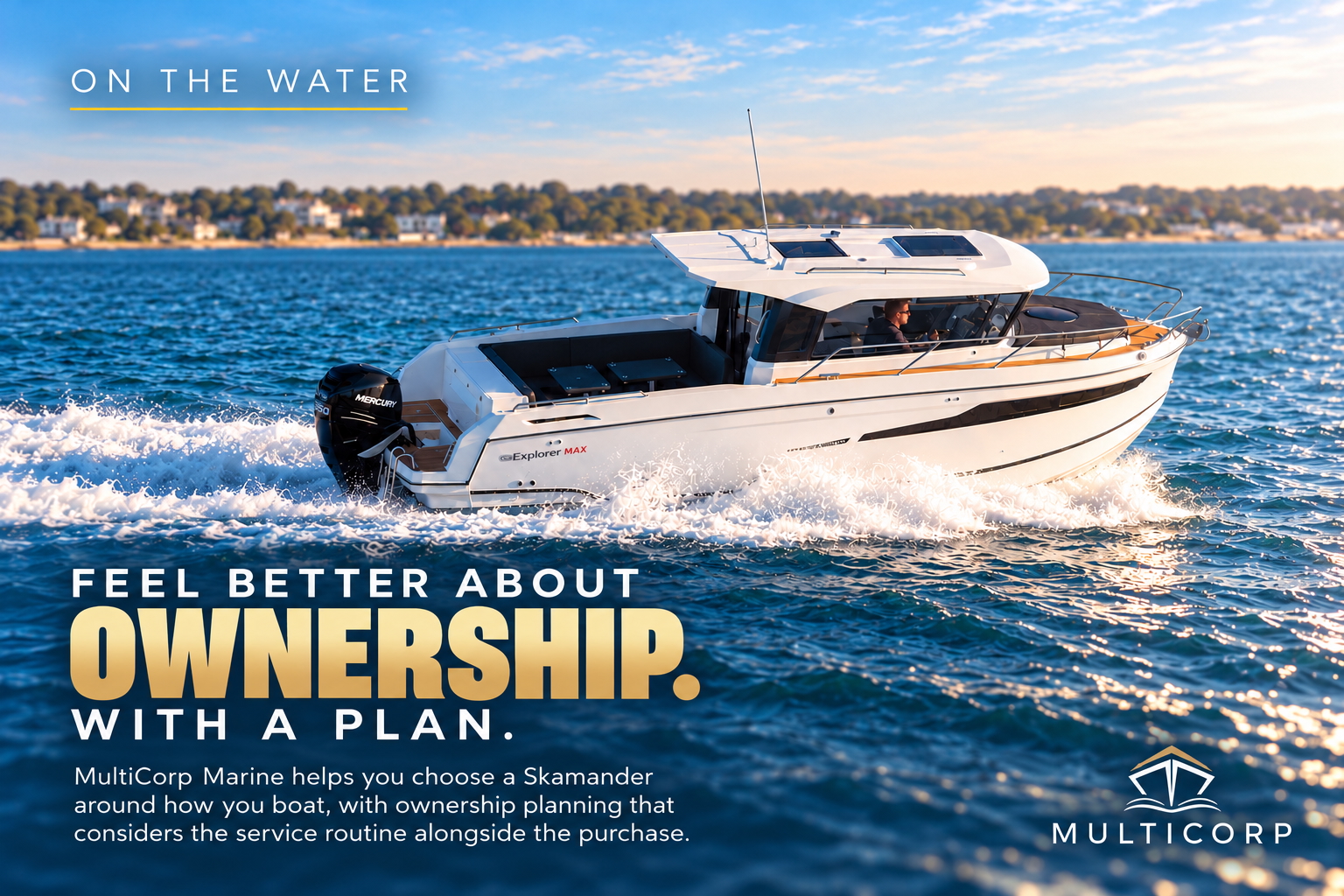
A larger outboard-powered leisure boat moves much of the routine engine work outside the hull. That can be a welcome change for an owner downsizing from an inboard cruiser. For someone upgrading from a single-engine boat, however, twin or triple outboards bring additional service parts and expense.
The useful comparison goes beyond outboards versus inboards. It is how each installation affects your annual operating costs and time lost to service.
Maintenance access improves, but the work remains
With outboards, technicians can reach the engines without entering an engine compartment. That is especially appealing if your current boat has a tight machinery space. A well-designed inboard engine room can be service-friendly too, so inspect the actual installation rather than judging by propulsion type alone.
Modern four-stroke outboards still require engine oil and filter changes. Gearcase lubricant and water-pump service remain on the schedule, along with corrosion-protection checks. Easier access does not remove those jobs or the manufacturer’s time-based and engine-hour service intervals.
Compared with a sterndrive, an outboard avoids the sterndrive’s transom bellows and separate engine-to-drive connection. A conventional shaft-drive inboard has its own service points, including shaft seals and bearings. These differences change the maintenance list, rather than making one system maintenance-free.
Access is also different from dockside serviceability. Lower-unit work may require lifting the boat, and closely spaced engines can complicate access. Before buying, ask how routine work will be performed on that particular boat. An upgrade from one engine to two can improve accessibility while increasing the annual service budget.
Judge efficiency by the trip, not the engine label
Outboards can support efficient boat designs, but fuel savings are not something to assume from the propulsion label. Hull design and operating speed can outweigh the difference between engine types.
Compare fuel used per nautical mile at a comfortable cruising speed, not just gallons per hour. A boat burning more fuel per hour may still use less over the same distance if it covers that distance efficiently.
For a useful sea-trial comparison:
- Record total fuel burn across all engines, not the reading for just one.
- Use realistic passenger loads and normal cruising gear.
- Check usable fuel capacity and allow a reserve when estimating range.
- Apply the fuel prices you expect to pay where you boat.
An efficient diesel inboard cruiser may compare favorably on longer passages, depending on the boat and speed. Gasoline-powered outboards are not automatically the lower-cost choice.
Annual use matters as well. For occasional outings, scheduled maintenance may influence the ownership budget more than a modest fuel saving. Owners covering long distances have more reason to scrutinize consumption at their preferred cruising speed.
Shallow-water flexibility is useful, not unlimited
Outboards can trim or tilt to reduce how far the propulsion equipment extends below the hull. That can help around shallow slips and during launching. Sterndrives offer similar adjustment, so the clearest contrast is with fixed-shaft inboards and their exposed running gear.
Running trim and full tilt serve different purposes. Underway, an outboard has to stay within the manufacturer’s operating limits, with adequate cooling-water supply and propeller immersion. Tilting farther clear of the water is primarily an at-rest option, not a way to run across a shallow flat.
The hull’s draft does not disappear when the engine comes up. On the Chesapeake Bay, changing water levels can alter access to a familiar creek. Inland lakes bring seasonal drawdowns and submerged hazards. Adjustable propulsion gives you more options, but depth and clearance still govern the decision.
Service availability matters more than a familiar badge
Outboards are widely used in recreational boating, but a nearby repair shop may not support your exact engine model or have the equipment to handle a larger boat. Local capability matters more than the number of service signs around the marina.
Confirm that a provider supports the engine brand and model you are considering. Then check the yard’s lift capacity and typical booking lead times. Easy engine access cannot compensate for an unavailable part or a full service calendar.
This is worth checking beyond your home port, too. An extended Great Lakes cruise can take you far from your usual technician. Knowing where suitable support is available makes a service interruption easier to manage, even though it cannot guarantee a quick repair.
At MultiCorp Marine, we help buyers select and configure Skamander by Parker Poland boats around their intended use, with ownership planning alongside the purchase. For qualifying customers, our Command365 program provides year-round service coordination and maintenance guidance, helping keep the service plan connected to how the boat is used.
Talk with us about choosing an outboard-powered Skamander and planning the service routine that comes with it.